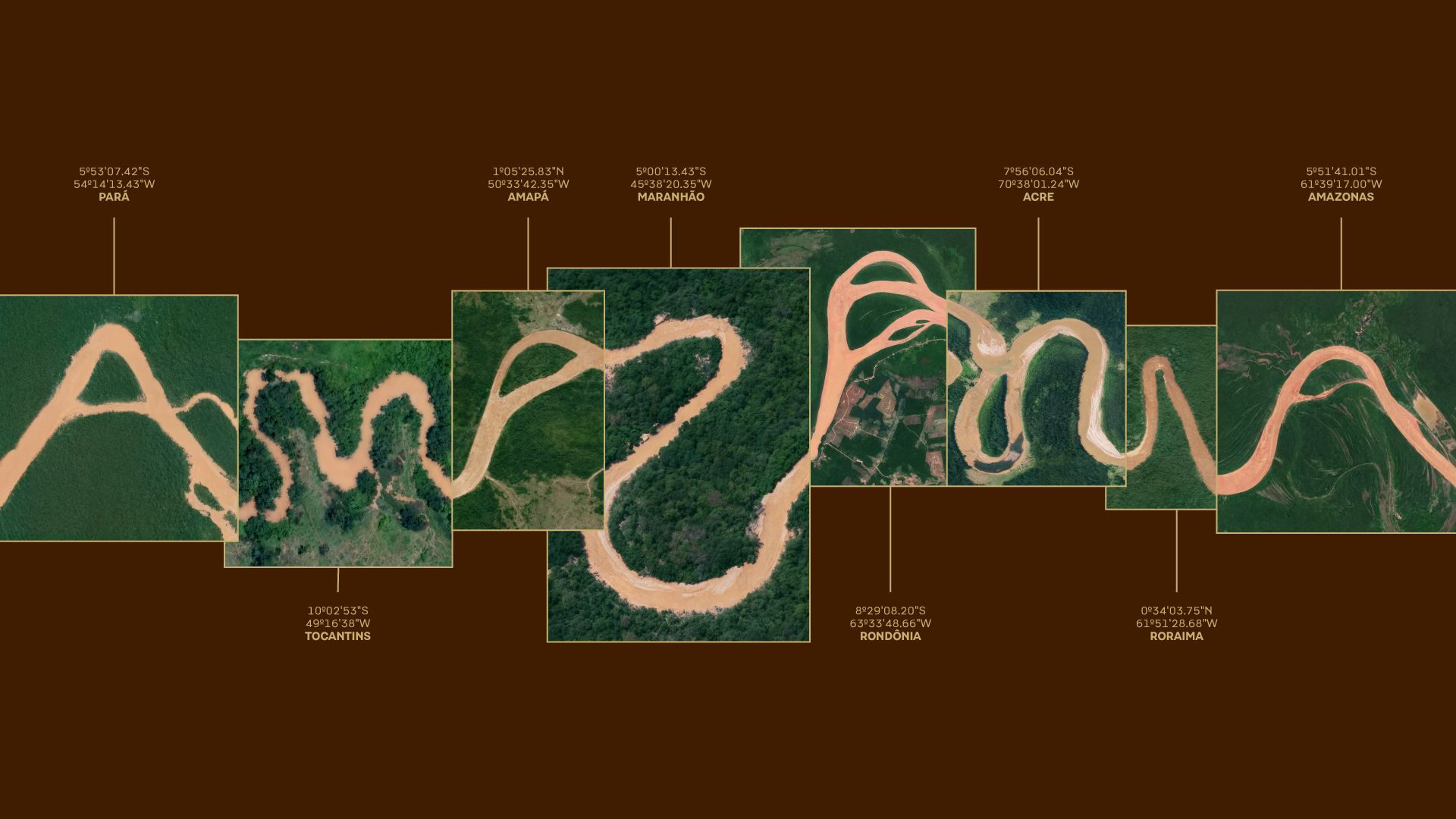
Letters shaped not by lines drawn in a computer program, but by the winding paths of Amazonian rivers. This was the concept behind the creation of the so-called “Amazon brand,” a new visual identity for the region aimed at boosting tourism, the bioeconomy and other businesses across the nine states that comprise it.
The project was conceived by the Agência Brasileira de Promoção Internacional do Turismo (Embratur) [Brazilian Agency for International Tourism Promotion] and Rotas Amazônicas Integradas (RAI) [Integrated Amazonian Routes], an initiative that brings together tourism departments from northern Brazilian states. It was developed by FutureBrand, a company based in São Paulo, with support from Amazonian artists. The new brand is intended to serve as a unified visual identity for the region, helping to strengthen its states as tourist destinations as well as their local economies.
Satellite imagery was used to turn the curves of rivers in the Amazon basin into the letters that make up the brand. Designers mapped 25,000 kilometers of the basin’s waterways, extracting not only the letters that spell Amazon but an entire alphabet, which they named "Igaratipo", a generative typeface created from real local rivers.
The initiative has been widely praised, but also strongly criticized for having been created by a company from outside the region, despite involving collaboration with local professionals. Critics argue that the creators are unfamiliar with the local reality, viewing the Amazon only “from above,” through satellite imagery. The designers, in turn, say their collaboration with local artists was intended precisely to express and respect the cultural diversity of Brazil’s largest region.
The new brand was officially delivered to RAI on April 16 at FutureBrand’s headquarters in São Paulo, transferring creative ownership to the collective. RAI then formally transferred the brand to the Amazon Legal Consortium, an entity that brings together the nine states of Brazil’s Legal Amazon (Acre, Amapá, Amazonas, Mato Grosso, Maranhão, Pará, Rondônia, Roraima and Tocantins) to strengthen cooperation among state governments.
“Promoting the Amazon is more strategic than promoting each state separately”
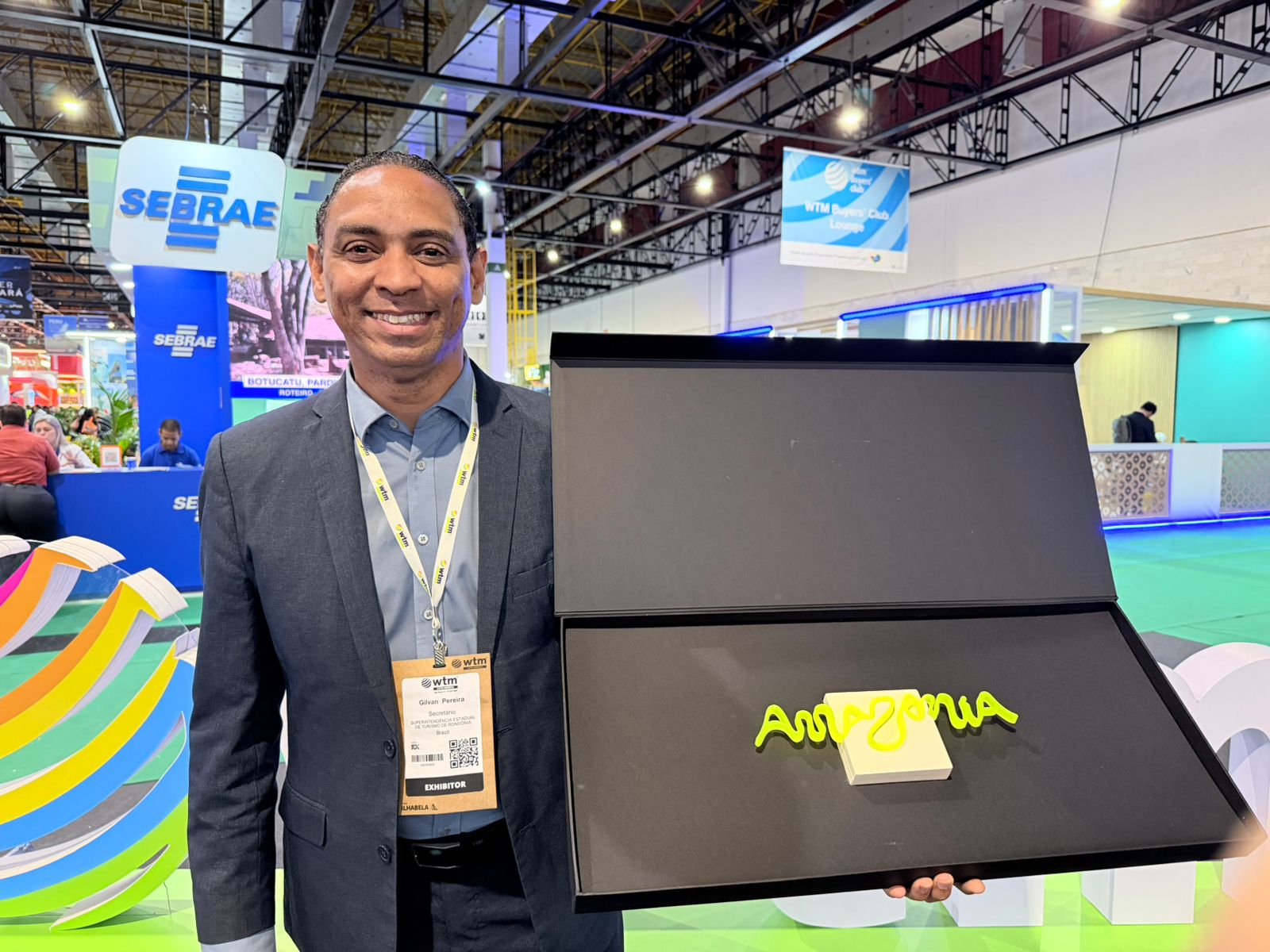
Gilvan Pereira Júnior, Rondônia’s Secretary of Tourism and current president of the RAI, explains that the creation of the brand was a strategic move. “Promoting the Amazon is far more strategic than promoting each state individually. The idea, then, was to create a brand that would unify all the states, and this opportunity arose when the company FutureBrand voluntarily donated the brand. The RAI recognized the importance of creating an identity capable of drawing attention to the region, based on features that represent our greater Amazon,” he argues.
According to him, the process took several months, with contributions from all the states and interviews with people living in the region. “Everything was verified by us, by those from the region. It was not imposed, it was something built collectively, combining the company’s technical expertise with the participation of Amazonian figures and artists. We want to promote this brand in a way that allows the world to understand the strength we have,” emphasizes Pereira Júnior.
Arnaldo Bastos, Creative Director at FutureBrand, explains that the idea emerged from a clear need: “Despite being one of the richest, most diverse, and symbolic territories in the world, the Amazon had never presented itself in a unified way. Historically, the states of the Legal Amazon operated with fragmented identities and communication efforts, which limited their potential for global positioning. The central objective was to transform the Amazon into a more desirable and internationally recognized asset, while also generating real value for those who live and produce in the region,” he states.
The creative process involves immersion
Arnaldo Bastos says that the creation process involved a deep immersion in the territory and its natural logic. “Instead of imposing an external language, the team sought to build the identity from the Amazon’s own patterns. It was in this context that the central insight emerged: to use geography itself as a language. Based on real coordinates from the Amazon River and its tributaries, it was possible to identify shapes that resembled letters of the alphabet in satellite images. This concept reinforces the idea of a ‘living brand,’ one that is born from the territory itself rather than from an external interpretation,” the designer explains.
The professional also emphasizes that the visual system was designed to be flexible and dynamic. “It allows for variations in colors and elements that enable adaptations according to region, context, and application, always highlighting local fauna, flora, culture, and diversity,” he explains.
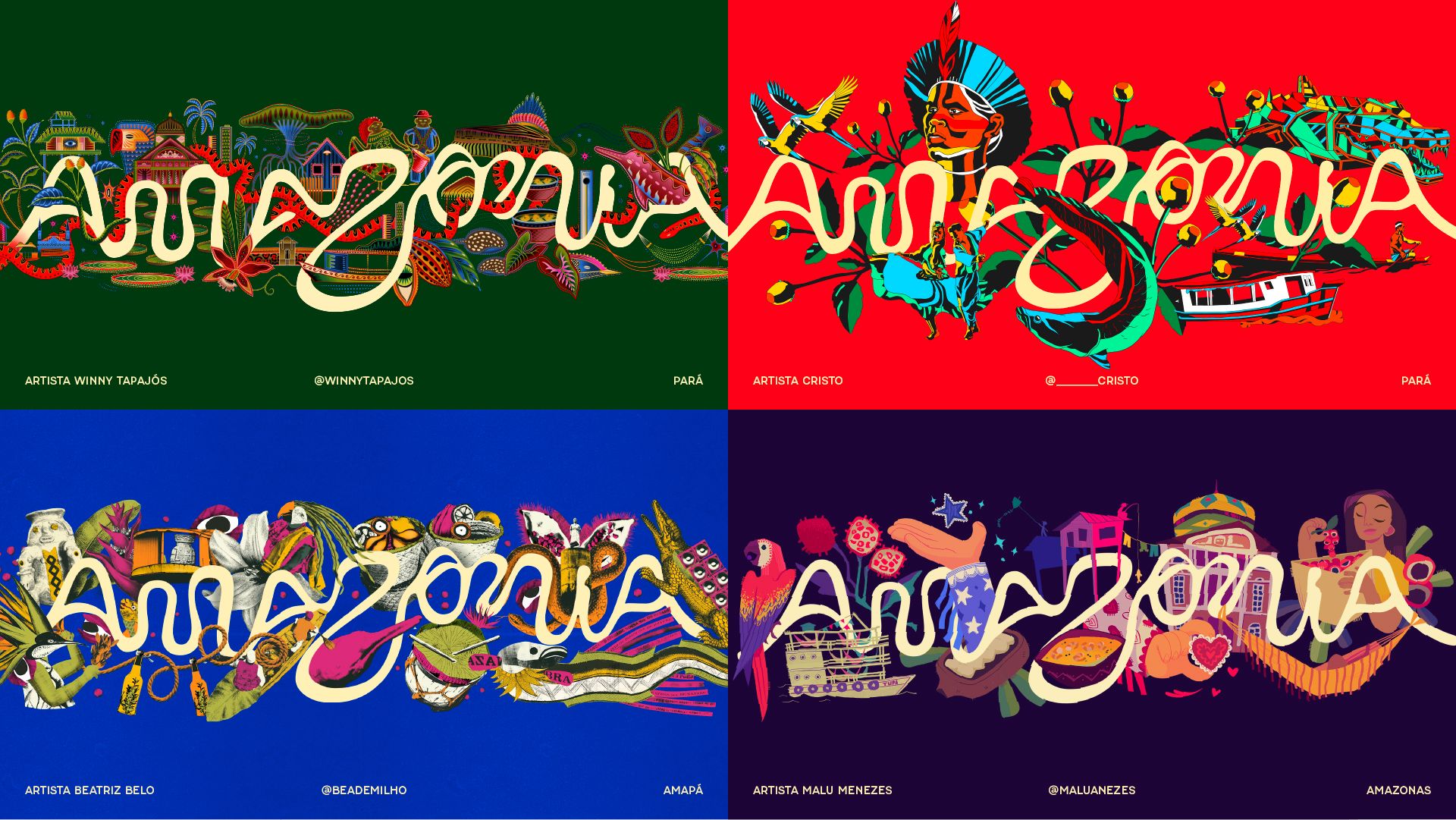
For Bastos, the participation of professionals from the Amazon itself was an essential part of the project, rather than merely a complement. “The brand was co-created with people from the region, including residents, workers, artists, and other representatives from the nine states. Several local talents contributed directly to the development of the project, such as illustrators (Cristo, Winny Tapajós, Malu Menezes, and Beatriz Belo), photographers (Ori Junior and Bob Menezes), as well as initiatives like the Instituto Letras que Flutuam, with type designer Odir Abreu. The audiovisual production was also carried out by a local production company, Marahu, from Pará,” he reports.
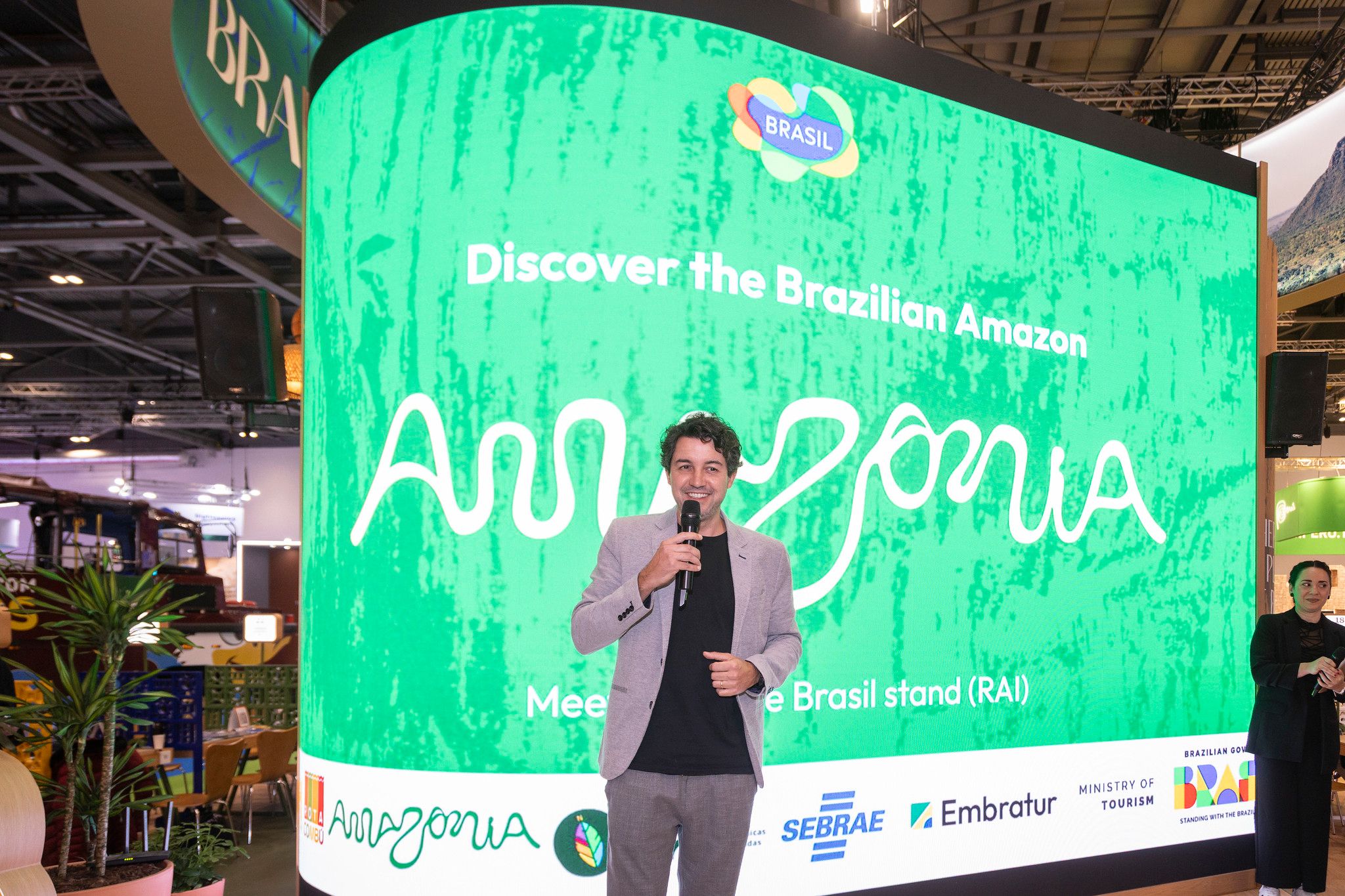
"The Amazonian perspective was essential to ensure that the outcome was both legitimate and representative. More than just aesthetics, this collaboration brought cultural depth, a sense of belonging, and a more authentic reading of the territory, avoiding stereotypes and strengthening the brand as a genuine expression of the region’s diversity and richness,” the specialist adds.
Illustrations, video, and website were created
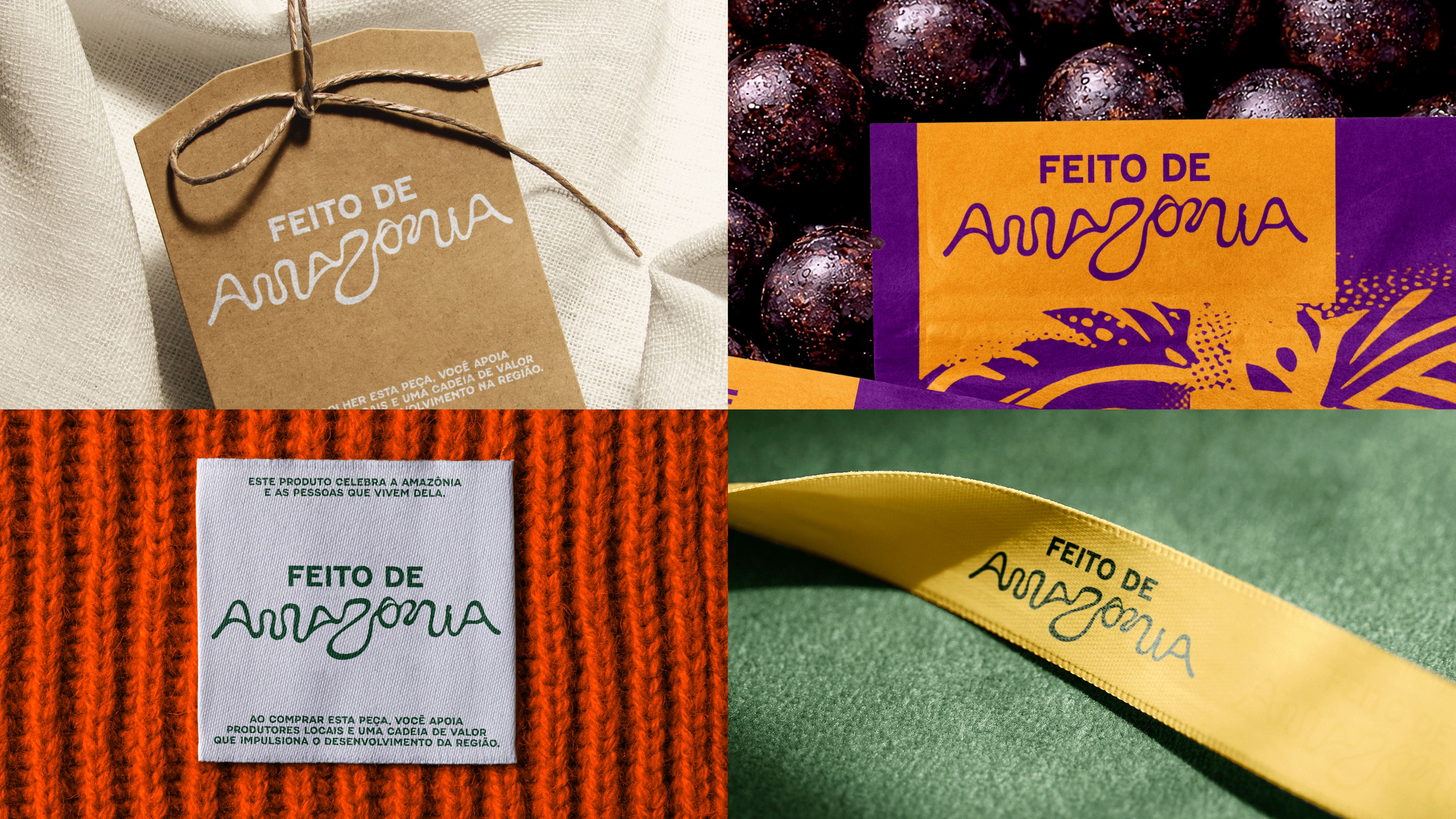
In addition to the brand itself, other assets were created, including illustrations, a video, and a website, the visiteamazonia.com.br, which explains the project and showcases experiences and destinations across the region. The initiative also includes the adoption of a label, “Feito de Amazônia” [Made of Amazon], which will be applied to local products to reinforce their Amazonian origin and increase their recognition both within Brazil and abroad.
“As for the label, nothing has been formally structured yet, but discussions have already taken place with Embratur, the Legal Amazon Consortium, and Sebrae Nacional, recognizing the need for such a label to strengthen products and foster both scale and a sense of belonging within our own region. In addition to promoting tourism, we are also considering presenting this brand in a commercial way, through bioeconomy products made in the Amazon. In a way, this helps develop a more differentiated perspective on Amazonian products,” highlights Gilvan Pereira Júnior, from the RAI.

"We have to speak of the Amazon in the plural”
Elson Santos, an advertising professional and professor at the Federal University of Pará (UFPA), believes that some of the criticisms of the project are valid. “Although it included artists from the region, the creation was led by a company that is not only from Brazil’s Southeast, but global. It’s complex, because we have always experienced this kind of erasure, people talking about the Amazon, rather than with the Amazon. I understand and agree with some of these criticisms. The use of satellite imagery was widely criticized, as if the region were seen only from above and not from within, without the creators coming here to truly understand the space. Alternatives could have been considered to bring more local protagonism, so that the Amazon brand could have been created here,” the professor says.
“In addition, Santos argues that the creative and methodological process may reinforce stereotypes about the region, as well as the idea of the Amazon as a singular entity. ‘We have to speak of the Amazon in the plural, because there are many Amazons,’ he emphasizes.”
On the other hand, the PhD candidate in Communication praises the inclusion of local artists in developing extensions of the brand, such as illustrators, which highlight the particularities of each state. "In my view, it is a beautiful project, technically well executed, and quite successful in bringing people from the North to collaborate,” he adds.
“I see the brand as much more positive than negative”
Joanna Martins, an advertising professional and currently a bioeconomy entrepreneur in Pará, likewise sees both positive and negative aspects in the creation of the brand. “I think any process can involve some mistake, some flaw. The Amazon is a very large territory, with different populations and cultures. Perhaps the process could have been more participatory, involving people from the territory. For me, the biggest mistake was the use of the wrong color in an illustration of the Caprichoso ox [red was used, a color associated with Garantido, Caprichoso’s rival], because that is indeed very serious for those from Amazonas who experience the Parintins Festival. So, if there had been greater participation from people in the region in the process, especially in leadership roles, perhaps this mistake could have been avoided. But I see the brand as far more positive than negative,” she says.
As a bioeconomy entrepreneur, Joanna Martins considers it essential to have a brand that brings about unification, helping to identify the territory both for the rest of Brazil and for the world. “Then, after that attention, each state, enterprise, or tourism product carries out its own commercialization. The unified brand brings this power of giving visibility to the region. But it is necessary to think about other actions from this point onward,” she states.
On whether the brand reinforces stereotypes, Joanna Martins believes that any territory, when seen from a distance, is viewed in a stereotypical way. “The only way we have to change this reality is by bringing people closer to the region. And if the intention of the brand is precisely to bring people closer, whether through visits or through the consumption of bioeconomy products, little by little, people begin to get to know the region, those who live in it, and our cultures,” she says.
INSTITUTIONAL PARTNERSHIP
The production of Liberal Amazon is one of the initiatives of the Technical Cooperation Agreement between the Liberal Group and the Federal University of Pará. The articles involving research from UFPA are revised by professionals from the academy. The translation of the content is also provided by the agreement, through the research project ET-Multi: Translation Studies: multifaces and multisemiotics.